Particle (Basic ㊦ 507)
A colloquial topic-introducer.
Equivalent: Speaking of ~
| Noun | って | |
| 先生って | Speaking of the teacher | |
| {V/Adjective い} informal nonpast | って | |
| 話すって | To talk (topic) | |
| 高いって | To be expensive (topic) |
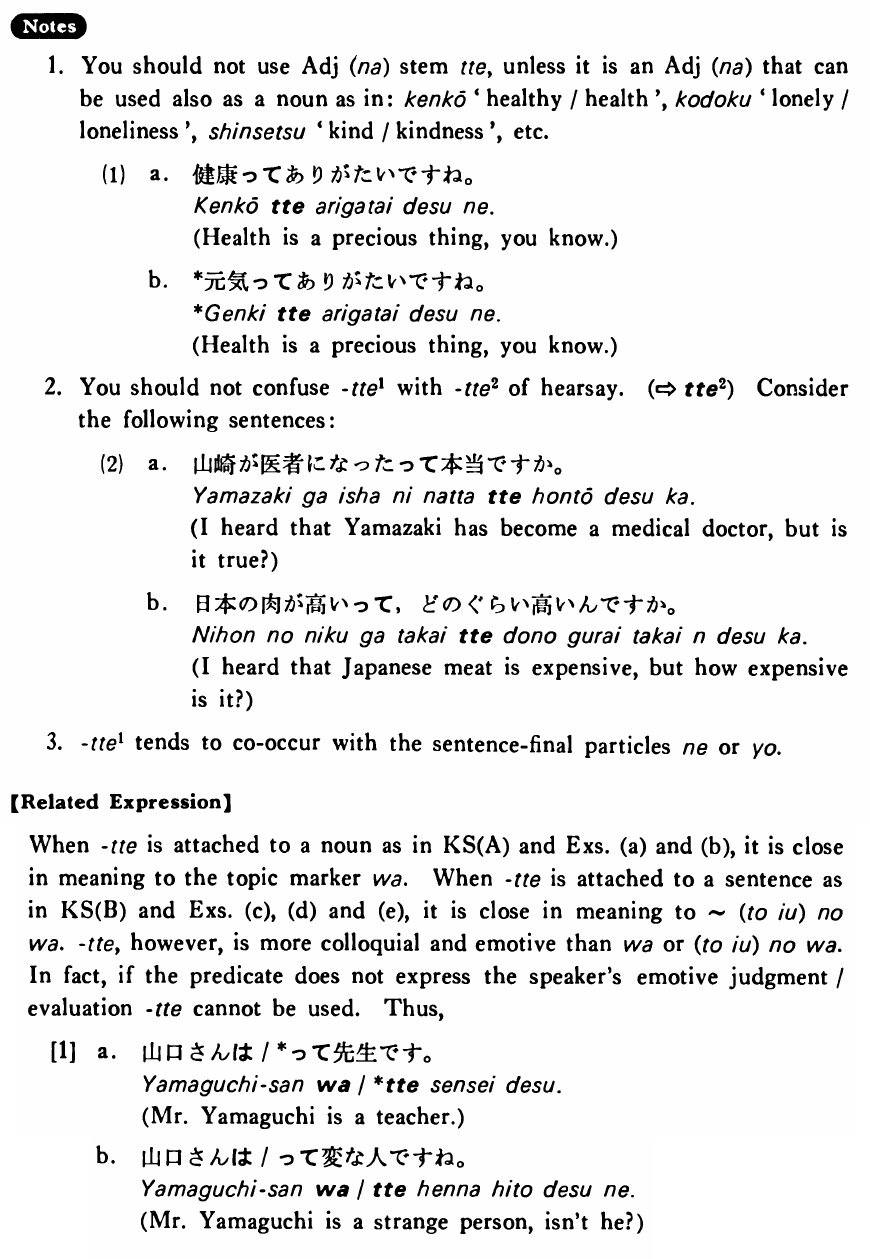
1. You should not use Adjective な stem って unless it is an Adjective な that can be used also as a noun as in: 健康 'healthy/heal', 孤独 'lonely/loneliness', 親切 'kind/kindness', etc.
2. You should not confuse って1 with って2 of hearsay. (⇨ って2) Consider the following sentences:
3. って1 tends to co-occur witn the sentence-final particles ね or よ.
【Related Expression】
When って is attached to a noun as in Key Sentence (A) and Examples (a) and (b), it is close in meaning to the topic marker は. When って is attached to a sentence as in Key Sentence (B) and Examples (c), (d) and (e), it is close in meaning to (という)のは. って, however, is more colloquial and emotive than は or (という)のは. In fact, if the predicate does not express the speaker's emotive judgment/evaluation って cannot be used. Thus,
[1]